

The Impossible Task of the Eccles Building
In the marble halls of the Eccles Building in Washington, D.C., a group of twelve men and women hold the levers of the American economy. The Federal Reserve, or “the Fed,” operates under a dual mandate from Congress: keep prices stable and maximize employment. When the Fed moves, the world trembles. Yet, over the last decade, a troubling pattern has emerged. From the “transitory” inflation narrative of 2021 to the delayed reactions to the 2008 housing bubble, the most powerful economic institution on earth seems to keep getting it wrong.
To understand why this happens, we have to look at how the Fed operates. It doesn’t use a crystal ball; it uses lagging indicators. By the time the Bureau of Labor Statistics (BLS) or the Bureau of Economic Analysis (BEA) releases data on inflation or GDP, that data is already weeks or months old. For the average Credible Cents reader, this “lag” is more than an academic curiosity—it is the difference between a 3% mortgage and a 7% mortgage, or the difference between a growing retirement account and one stalled by a recession.
The ‘Transitory’ Trap and the Data Lag
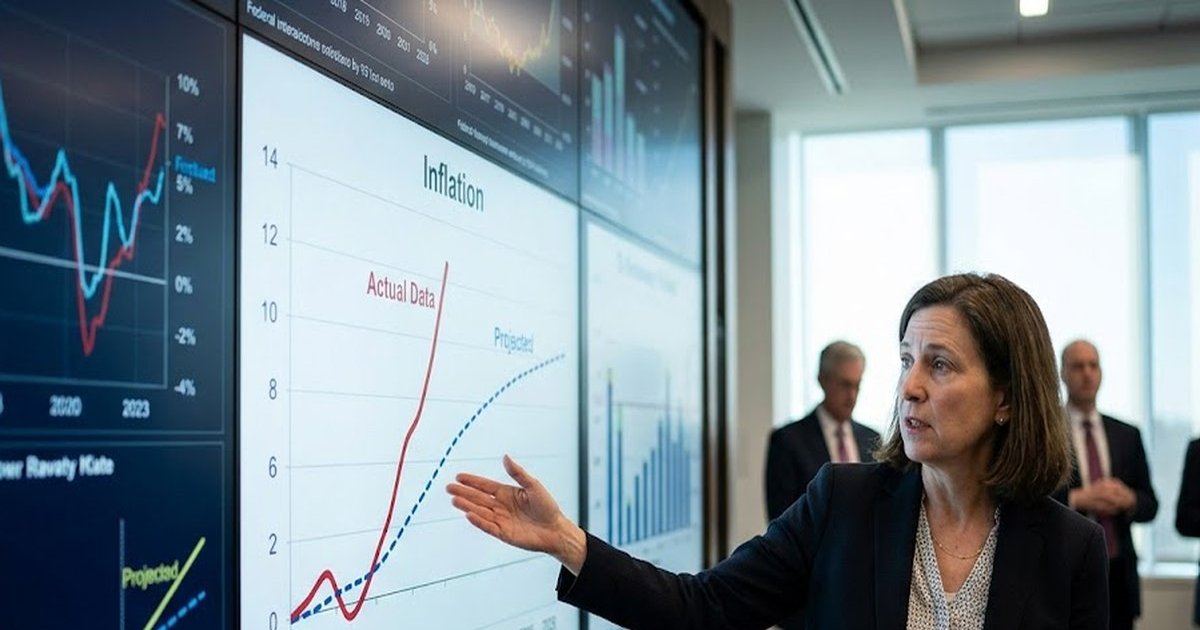
Perhaps the most famous recent misstep occurred in 2021. As the Consumer Price Index (CPI) began to climb, Fed Chair Jerome Powell repeatedly characterized inflation as “transitory.” In April 2021, the CPI rose 4.2% year-over-year; by December, it had hit 7%. Yet, the Fed didn’t begin raising the federal funds rate from its near-zero floor until March 2022. By then, the horse had not only left the barn but was halfway across the county.
Why did they wait? The Fed relies heavily on the “Phillips Curve,” an economic theory suggesting that as unemployment falls, inflation must rise. However, the Congressional Budget Office (CBO) has noted that this relationship has “flattened” significantly since the 1980s. By sticking to old models in a post-pandemic world of snarled supply chains, the Fed stayed “dovish” (keeping rates low) for too long. For your wallet, this meant that by the time the Fed started fighting inflation, the purchasing power of $1,000 in January 2021 had dropped to roughly $915 by the end of 2022.
The Echo Chamber of Economic Modeling
The Federal Reserve employs over 400 Ph.D. economists. While brilliance is not in short supply, cognitive bias often is. The Fed’s primary forecasting tool, the “Summary of Economic Projections” (better known as the Dot Plot), frequently misses the mark. For example, in December 2020, the median Fed official projected that interest rates would remain at 0.1% through the end of 2023. In reality, the rate ended 2023 at over 5.25%.
This discrepancy happens because the Fed’s models are often “mean-reverting.” They assume that if the economy deviates from the norm, it will naturally swing back to a 2% inflation target. But real-world shocks—like a global pandemic, the war in Ukraine, or sudden shifts in consumer behavior—don’t follow a bell curve. When the Fed gets the forecast wrong, they are forced to overcorrect. These “volatility spikes” lead to the boom-and-bust cycles that make it difficult for families to plan for long-term goals like buying a home or starting a business.
The Wealth Effect and the Inequality Gap
When the Fed “gets it wrong” by keeping rates too low for too long, it creates an environment of “cheap money.” While this sounds good for borrowers, it often leads to asset bubbles. According to data from the Federal Reserve’s own “Distributional Financial Accounts,” the top 1% of U.S. households hold about 30% of total household wealth, much of it in stocks and real estate. Low rates pump up these asset prices.
Conversely, when the Fed realizes they’ve missed inflation and hikes rates aggressively, the “bottom 50%” of households—who rely more on wages than assets—feel the sting of higher credit card interest rates and auto loans. As of late 2023, the Federal Reserve Bank of New York reported that total credit card debt had surpassed $1 trillion. When the Fed raises rates to fix their previous mistakes, they are essentially making it more expensive for the average American to carry that debt, effectively “taxing” the public for the central bank’s lack of foresight.
The National Debt Dilemma
The Fed’s miscalculations also have a massive impact on the U.S. national debt. As the CBO has warned, as interest rates rise, the cost of servicing our national debt (which exceeded $34 trillion in 2024) skyrockets. In 2023 alone, interest payments on the debt reached $659 billion. Every time the Fed misjudges the timing of a rate hike or cut, they influence how much of your tax dollars go toward paying interest rather than funding infrastructure, education, or healthcare.
For the individual, this means a future of likely higher taxes or reduced services. The Fed’s inability to maintain a “Goldilocks” economy—not too hot, not too cold—creates a fiscal drag that lingers for generations. Understanding that the Fed is reactive, rather than proactive, is the first step in protecting your personal finances from their inevitable course corrections.
Frequently Asked Questions
Why doesn’t the Fed just keep interest rates the same all the time?
If the Fed kept rates static, they couldn’t respond to economic crises like the 2008 crash or the 2020 lockdowns. However, the challenge is that their “responses” are often based on old data, leading to the delayed reactions we see today.
How does a Fed rate hike actually affect my bank account?
When the Fed raises the federal funds rate, banks increase the cost of borrowing for mortgages, credit cards, and auto loans. On the flip side, you might see a slight increase in the interest paid on your high-yield savings account, though these “deposit rates” usually rise much slower than loan rates.
Is inflation always the Fed’s fault?
Not entirely, as global events like oil shortages or supply chain breaks also drive prices up. However, the Fed is responsible for the “money supply,” and by keeping rates low and printing money through “Quantitative Easing,” they provide the fuel that allows inflation to burn longer and hotter.
This article was produced with AI assistance and reviewed by a human editor for accuracy and clarity. For more about our editorial standards, visit our About page.