

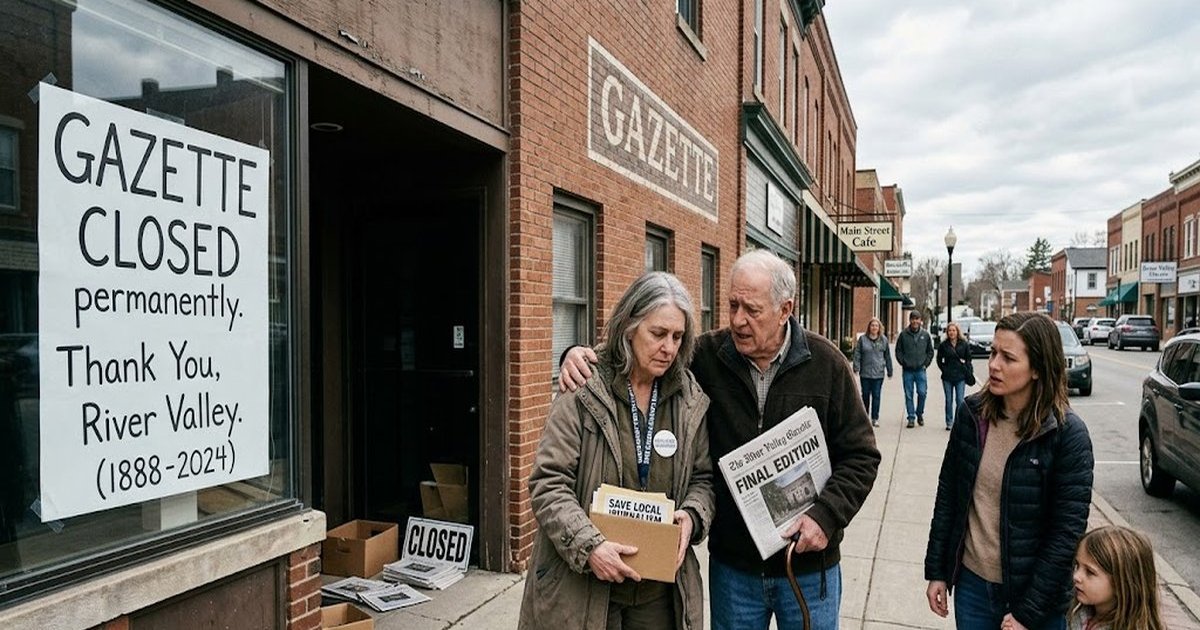
Think back to your childhood Sunday mornings. You likely remember the sound of a heavy newspaper hitting the porch. You read about the high school football scores. You saw who got married or passed away. Most importantly, you knew what was happening at the town hall.
That world is fading fast. Across our great country, local newsrooms are locking their doors. Since 2005, the United States has lost nearly 2,900 newspapers. This data comes from a 2023 report by the Medill School of Journalism at Northwestern University.
When a local paper dies, the community loses its pulse. We lose the “watchdog” that keeps an eye on how our tax dollars are spent. This is not just about missing the grocery coupons. It is about the health of our republic and the safety of our families.
The Rising Cost of Silence
Many people think Facebook or X can replace the local paper. But social media does not send a reporter to a four-hour school board meeting. It does not check if the new bridge was built with quality steel. When the local reporter leaves, the “sunlight” on local government goes dark.
There is a real cost to this lack of oversight. A 2018 study from the University of Illinois and the University of Notre Dame looked at “news deserts.” These are places with no local newspaper. The researchers found that when a paper closes, local government costs go up.
Without a reporter in the room, city leaders may spend more freely. Borrowing costs for the city increase. The study shows that taxes often rise because there is no one to point out waste. As Margaret Sullivan wrote in her book Ghosting the News, “Local journalism is the glue that holds a community together.”
When that glue fails, our wallets feel the pinch. We end up paying more for a government that does less. For hardworking American families, every dollar counts. We cannot afford to lose the people who keep our local officials honest.
Loss of Community and Values
Local news does more than just watch the budget. It tells the story of our neighbors. It highlights the local bake sale, the VFW meeting, and the church fundraiser. These stories build what we call “social capital.”
A 2018 report from the Pew Research Center found that local news is a top source for community info. People who read local news are more likely to vote. They are more likely to volunteer. They feel a stronger bond with their neighbors.
When we lose the paper, we lose that bond. We stop looking at each other and start looking at the national fights in Washington, D.C. This makes us feel more divided. We forget that we all want the same things for our kids and our streets.
The loss of local news also hurts our faith in the system. According to a 2022 survey by the Knight Foundation, Americans trust local news more than national news. People trust what they can see with their own eyes. They trust the reporter they see at the grocery store.
The Threat to Accountability
Our Constitution was built on the idea of a free press. The Founders knew that power needs a check. In local towns, that check is the local editor. Without them, corruption can grow in the shadows.
The Associated Press reports that thousands of communities now have no local news source. In these towns, voters often do not know who is running for office. They might not know about a new zoning law that hurts their property value. This is a direct hit to our “consent of the governed.”
Steve Waldman is the president of Report for America. He stated, “The collapse of local news is a crisis for our democracy.” He argues that we need more “boots on the ground” in small towns. We need people who care about the local water board as much as the White House.
Many of these newsrooms were family-owned for decades. They shared our values. Now, many are owned by large hedge funds. These big companies often cut staff to save money. This leaves one or two people to cover an entire county. It is simply not enough to keep the powerful in check.
How We Can Fight Back
The news is not all bad. Some communities are finding new ways to stay informed. In some places, non-profit newsrooms are starting up. In others, small-town leaders are encouraging local citizens to attend meetings and post factual updates.
We must value the truth over “likes” on a screen. We can support the small papers that are still standing. A subscription is a small price to pay for a more honest local government. It is an investment in our town’s future.
We should also teach our children and grandchildren to care about local issues. Show them the local section of the paper. Talk to them about why the town council matters. Our American way of life starts at the local level. If we do not protect it there, we will lose it everywhere.
The death of local news is a quiet crisis. It does not make big headlines in New York or Los Angeles. But it is felt in every small town and suburb. It is time we start paying attention before the last press stops running for good.
Frequently Asked Questions
Why are local newspapers closing so fast?
Many local papers lost their main income when businesses moved ads to the internet. According to the Medill School at Northwestern, the U.S. has lost about one-third of its newspapers since 2005.
How does a missing newspaper affect my local taxes?
Research from the University of Notre Dame shows that local government costs go up when papers close. Without a reporter watching, there is less pressure to cut waste or keep borrowing low.
Is social media a good replacement for local news?
Not usually, because social media often lacks factual checking and deep reporting. A 2022 Knight Foundation study found that Americans still trust local journalists far more than what they read on social media.