

The Mandate: Federal Rules vs. Local Budgets
Every American parent wants the same basic things for their children: a safe environment, dedicated teachers, and a high-quality education that prepares them for the future. Yet, across the nation, local school districts are facing unprecedented financial pressures. While national policy discussions about education often center on curriculum standards or school choice, one of the most significant and frequently overlooked factors impacting local school budgets is the financial cost of educating undocumented students.
To understand the current landscape, we must first look at the constitutional and legal framework that governs our public education system. Under the United States Constitution, the federal government has the sole authority over immigration policy and securing the national border. However, under the Tenth Amendment, the administrative power and financial responsibility of operating public schools is reserved to the states and local municipalities. This separation of powers creates a unique structural friction point when federal immigration realities intersect with local municipal budgets.
The foundational rule governing this issue is the 1982 United States Supreme Court decision in Plyler v. Doe. In that landmark ruling, the Court determined that public schools cannot constitutionally deny undocumented children access to a free, public K-12 education. Citing the Equal Protection Clause of the Fourteenth Amendment, the Court established a strict federal mandate that all children physically present in the United States, regardless of their legal immigration status, must be enrolled in local public schools.
For more than four decades, this ruling has shaped public education. However, the scale and scope of immigration have changed dramatically since 1982. Because the federal government dictates immigration enforcement but provides less than 15 percent of total public school funding, the financial realities of this federal mandate fall disproportionately on everyday Americans through state income taxes and local property taxes. When federal policies shift or border encounters rise, it is the local homeowner, the neighborhood school board, and the classroom teacher who must balance the books and stretch the resources. This dynamic raises essential questions about government accountability and the true financial cost borne by local communities.
The Numbers: Examining the Data on Enrollment
Tracking the exact cost of undocumented immigration on public schools is complex, primarily because federal law does not require schools to check or report the immigration status of their students. The Government Accountability Office (GAO) has historically noted that current government information is insufficient to directly estimate the exact state-by-state costs, as school districts routinely record enrollments and dollar expenditures but not immigration status. However, by analyzing demographic data, school enrollment figures, and average per-pupil spending, researchers and policy analysts can paint a highly accurate picture of the economic impact.
According to a 2023 analysis by the Heritage Foundation, the influx of unaccompanied minors crossing the border has resulted in substantial new costs for public school systems. Nationwide, U.S. Customs and Border Protection (CBP) encountered more than 145,000 unaccompanied minors in Fiscal Year 2023 alone. If each of those children were enrolled in a public school, based on the national average public school spending of $16,345 per student, the additional cost to the national education system would exceed $2 billion for a single year.
This financial burden is not distributed evenly across the country; it is heavily concentrated in specific destination states and local communities. The Heritage Foundation calculated the potential one-year educational impact on four deeply affected states based on Fiscal Year 2023 data:
- New York: Absorbing over 8,400 unaccompanied minors cost an estimated $240 million, driven by the state’s high $28,261 per-pupil spending average.
- Texas: Adding over 16,300 unaccompanied minors required roughly $228 million in local education costs based on a $13,900 per-pupil average.
- California: The state faced an estimated $189 million in additional educational expenses to accommodate unaccompanied minors.
- Arizona: The state saw an increased burden of more than $10 million for taxpayers.
Furthermore, broader data from the Center for Immigration Studies in 2021 estimated that approximately 29 percent of public school students from immigrant households—amounting to roughly 3.2 million children—were from households headed by an undocumented immigrant. Since 2021, those numbers have only grown as border encounters have reached record highs. For everyday taxpayers, these numbers represent real dollars that must be generated through taxes or diverted from other community needs, school infrastructure projects, and teacher salaries.
The Classroom Impact: Resources, Ratios, and Specialized Instruction
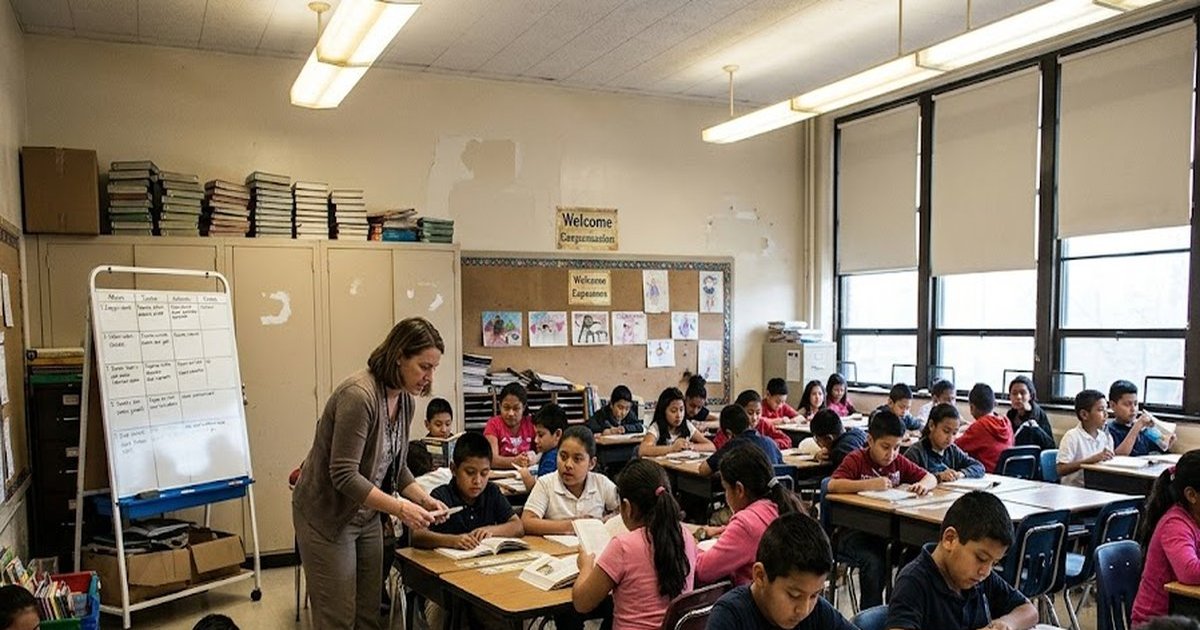
Beyond the raw financial data, the enrollment of newly arrived undocumented students introduces distinct operational challenges that affect the daily lives of all students and teachers. Education is not a flat-rate enterprise. The cost of educating a student increases significantly when that student requires specialized instruction, translation services, or additional social and academic support.
One of the most direct impacts on local schools is the dramatically increased need for English Language Learner (ELL) programs. When children arrive in the United States with little to no English proficiency, schools are legally required to provide specialized language instruction to ensure they can participate meaningfully in the standard curriculum. This requires hiring specialized ELL teachers, purchasing bilingual educational materials, and often employing classroom aides or translators. In many school districts, there is already a severe, pre-existing shortage of qualified ELL instructors. To meet the federal requirement, schools must offer highly competitive salaries or rely on emergency credentials, further straining the budget.
These localized challenges directly impact the student-to-teacher ratio. As enrollments unexpectedly spike during the academic year due to ongoing migration patterns, districts frequently find themselves scrambling to add portable classrooms, hire mid-year staff, or increase the number of students in existing classrooms. For the average American family, classroom overcrowding is a critical concern. Larger class sizes mean that teachers have less individualized time to spend with each student, which can impact academic outcomes and classroom discipline across the board.
Moreover, many newly arrived students have experienced significant gaps in their formal education before arriving in the United States. Integrating students who may be several years behind their expected grade level requires intensive remedial instruction. Schools are also increasingly tasked with providing access to school counselors and social workers to assist students navigating difficult transitions. While these are essential services for integrating new students, they are highly expensive. When a school district’s budget is fixed for the year, an unexpected surge in students requiring high-level support means that local administrators are forced to reallocate funds. Often, this results in cutting back on other educational priorities, such as gifted and talented programs, arts and music education, advanced placement courses, or extracurricular activities that local families value and expect.
The Funding Gap: Who Foots the Bill?
To fully grasp why this issue frustrates so many local taxpayers, one must look at how public education is actually funded in the United States. The system is heavily reliant on the financial backing of local communities. According to national fiscal data, public schools receive nearly 85 percent of their total funding from state and local sources. Specifically, hundreds of billions of dollars are generated directly from local property taxes assessed on homeowners and businesses.
When the federal government makes policy decisions regarding border security and immigration enforcement, it does not simultaneously send a blank check to local school districts to cover the resulting educational costs. The federal contribution to K-12 education remains relatively small—typically hovering around 10 to 12 percent of a district’s total revenue. This federal funding is largely distributed through specific grants, such as Title I for low-income schools or Title III for language instruction. While states can reserve a portion of Title III funds for immigrant subgrants, these federal dollars cover only a fraction of the actual, on-the-ground costs of hiring new teachers, building new school facilities, or purchasing specialized curricula.
This dynamic strikes at the heart of government accountability. Federal policymakers often mandate the assimilation and education of undocumented populations, yet they systematically pass the financial responsibility down to the municipal level. For the everyday American homeowner, this translates to a difficult economic reality: when local school budgets face a critical shortfall due to surging enrollments, the most common solution proposed by local governments is a ballot measure to increase local property taxes or issue new municipal bonds.
This structural disconnect forces local communities to bear the financial weight of federal policy decisions. It highlights a tension in localized governance when federal mandates dictate local tax burdens without accompanying compensation. The lack of transparent data collection also hinders effective municipal planning. Because schools do not systematically collect or report data on the immigration status of their students, city councils and school boards are left guessing at the true economic impact year over year, making it nearly impossible to budget accurately for the future or protect existing educational programs.
Conclusion: The Need for Transparency and Accountability
The national debate over immigration is often framed in broad, ideological terms, but the most profound impacts are felt locally, in our neighborhoods and our public schools. The economic data clearly demonstrates that educating undocumented students costs American taxpayers billions of dollars annually. This financial burden is heavily concentrated in specific communities that are already stretching their educational budgets to the absolute limit.
While public school teachers and administrators remain committed to providing a safe and effective learning environment for every child who walks through their classroom doors, the financial math facing local municipalities is unforgiving. Relying heavily on local property taxes to fund federal immigration mandates is an unsustainable economic model that ultimately impacts the quality of education and available resources for all students. Moving forward, a true commitment to government accountability requires honest accounting, transparent data collection, and a serious national conversation about aligning federal policies with local funding realities.
Frequently Asked Questions
Does the federal government pay for the education of undocumented students?
The federal government provides only a small fraction of overall public school funding, typically around 10 to 12 percent. The vast majority of the financial burden for educating all students, including undocumented children, falls on state governments and local property taxpayers.
Can local public schools turn away undocumented children?
No, public schools cannot deny enrollment based on immigration status. A 1982 Supreme Court ruling, Plyler v. Doe, established that all children physically present in the United States have a constitutional right to access free, public K-12 education.
How does the enrollment of non-English speaking students impact school budgets?
Students who require English Language Learner (ELL) programs necessitate additional specialized resources, bilingual teachers, and translation services. These legally required educational supports increase the per-pupil cost significantly compared to standard classroom instruction.
This article was produced with AI assistance and reviewed by a human editor for accuracy and clarity. For more about our editorial standards, visit our About page.