
The Shifting Landscape of the American Heartland
The American farm is more than just a plot of dirt; it is the bedrock of our nation’s independence, our economy, and our traditional family values. For generations, the family farm has represented the ultimate realization of the American Dream—a place where hard work, faith, and self-reliance yield the food that feeds our country and the world. But today, the landscape of American agriculture is shifting under our feet. A quiet, systematic trend has been unfolding across our rural counties, raising urgent questions about national security, food sovereignty, and government accountability. Foreign entities are increasingly buying up American farmland, and a highly scrutinized portion of those buyers are tied directly to our greatest geopolitical competitors.
According to the U.S. Department of Agriculture’s (USDA) latest Agricultural Foreign Investment Disclosure Act (AFIDA) report, delivered to Congress in early 2026, foreign investors now hold an interest in roughly 46 million acres of U.S. agricultural land. To put that into perspective, that is roughly 3.6 percent of all privately held agricultural land in the United States. While the majority of this land is held by investors from allied nations like Canada and the Netherlands—often leased for wind and solar energy projects—a distinct and deeply concerning portion belongs to entities from adversarial nations.
Specifically, USDA data indicates that Chinese entities are linked to roughly 277,000 acres of American agricultural land. At first glance, some mainstream media commentators dismiss this number as a drop in the bucket, quickly pointing out that it accounts for a fraction of a percent of all U.S. farmland. But focusing solely on the raw acreage misses the forest for the trees. The primary concern of conservative lawmakers, national security experts, and everyday Americans is not just the quantity of the land being purchased, but the strategic quality and the highly suspicious locations of these acquisitions.
Location, Location, Infiltration: The Grand Forks Wake-Up Call
The stark reality of this national security threat was exposed in late 2021, when a seemingly standard real estate transaction in North Dakota set off alarm bells at the highest levels of the Pentagon. The Fufeng Group, a Chinese agribusiness with undeniable ties to the Chinese Communist Party, purchased 370 acres of farmland in Grand Forks for approximately $2.6 million. The company claimed the land would be used to build a benign wet corn milling and biofermentation plant, bringing jobs and tax revenue to the local community.
However, local citizens, patriotic state leaders, and national security analysts quickly realized a glaring issue: the purchased farmland was situated a mere 12 miles from the Grand Forks Air Force Base. This specific base is not just a standard military outpost; it houses highly sensitive military drone technology and operates a vital space networking center. The proximity of a Chinese-owned facility to such critical, top-secret military infrastructure presented an obvious vulnerability for espionage, signal interception, and surveillance.
Conservative leaders, including Senators Marco Rubio (R-FL), John Hoeven (R-ND), and Kevin Cramer (R-ND), immediately sounded the alarm, demanding that the Committee on Foreign Investment in the United States (CFIUS) review the purchase. In late 2022, CFIUS determined they lacked the specific jurisdictional authority to block the greenfield purchase under existing rules. This bureaucratic loophole left the local community and state leaders to fend for themselves.
Thankfully, common sense eventually prevailed. In early 2023, the U.S. Air Force issued a stark, unambiguous warning to the city, stating that the proposed project presented “a significant threat to national security with both near- and long-term risks of significant impacts to our operations in the area.” Armed with this definitive assessment, the Grand Forks City Council officially terminated the development agreement with Fufeng USA, effectively stopping the project in its tracks. The Grand Forks incident served as a massive wake-up call to the nation: our federal laws were outdated, and foreign adversaries were legally purchasing land within earshot of our most sensitive military operations.
The Arkansas Blueprint: States Stepping Up to Protect the Homeland
In the absence of aggressive and immediate federal intervention, conservative state leaders have taken up their constitutional mantle to protect their citizens and their sovereign land. Currently, over 24 states have implemented some form of restriction on foreign ownership of agricultural land, but Arkansas has recently emerged as a gold standard for decisive, unapologetic action.
In April 2023, Arkansas Governor Sarah Huckabee Sanders signed Act 636, a robust piece of legislation that strictly bans prohibited foreign entities—specifically including Chinese state-owned enterprises—from owning agricultural land within the state’s borders. The state did not just pass the law for positive press; they immediately flexed their enforcement muscles.
In October 2023, Governor Sanders and Arkansas Attorney General Tim Griffin made national headlines when they ordered Northrup King Seed Co., a subsidiary of Syngenta, to divest itself of 160 acres of agricultural land in Craighead County within two years. Syngenta is ultimately owned by ChemChina, a Chinese state-owned enterprise. In addition to the forced sale, Attorney General Griffin slapped the company with a $280,000 civil penalty—representing 25 percent of the property’s fair market value—because the company failed to report its ownership to the state in a timely manner as required by law.
Governor Sanders summarized the conservative perspective perfectly during her press conference: “Seeds are technology. Chinese state-owned corporations filter that technology back to their homeland, stealing American research, and telling our enemies how to target American farms.” This enforcement action wasn’t just about 160 acres of dirt; it was about protecting American agricultural intellectual property and asserting state sovereignty. The Arkansas blueprint proves that when federal bureaucracies drag their feet, local and state governments have the power and the duty to defend their own backyards.
Federal Accountability and the USDA’s Blind Spots
While states like Arkansas and North Dakota are holding the line, everyday Americans are rightfully asking: why did the federal government let this happen in the first place? The answer boils down to outdated legislation, a severe lack of transparency, and bureaucratic blind spots in Washington.
For decades, the primary tool for tracking foreign land purchases has been the Agricultural Foreign Investment Disclosure Act (AFIDA) of 1978. Under AFIDA, foreign investors are legally required to report their agricultural land holdings to the USDA. However, a recent study by the U.S. Government Accountability Office (GAO) revealed severe flaws in the system, noting that the data collection was incomplete, largely paper-based, and heavily reliant on the honor system of self-reporting.
Under immense pressure from conservative lawmakers and transparency advocates, the USDA finally took a step into the 21st century. In January 2026, the USDA launched a new online portal designed to streamline the reporting of foreign-owned agricultural land transactions and improve compliance. While this digital modernization is a welcome improvement, many lawmakers argue it still does not go far enough to actively protect national security.
To close these glaring loopholes, conservative leaders in Congress are pushing for stronger, proactive enforcement. Just recently, on March 25, 2026, U.S. Senator Pete Ricketts (R-NE) introduced the Property Location Oversight and Transparency (PLOT) Act. This crucial piece of legislation aims to combat Communist China’s strategy of buying American farmland by lowering the foreign ownership reporting thresholds. Specifically, the PLOT Act decreases the reporting threshold for a single foreign adversary from 10 percent to 5 percent and requires the USDA to establish publicly accessible, open-source geospatial data of foreign agricultural land acquisitions.
Why does geospatial data matter? Because a paper form sitting in a filing cabinet doesn’t tell the Pentagon if a newly purchased farm shares a fence line with a nuclear silo or a power grid hub. Geospatial mapping allows the Department of Defense and intelligence agencies to visually track and identify proximity risks in real-time. As Senator Ricketts plainly stated, the PLOT Act is designed to combat bad actors who “have purchased land around military installations to weaken U.S. national security.” It is a common-sense measure designed to force accountability and bring these shadowy transactions into the light of day.
Food Security is National Security: Protecting the Family Farm
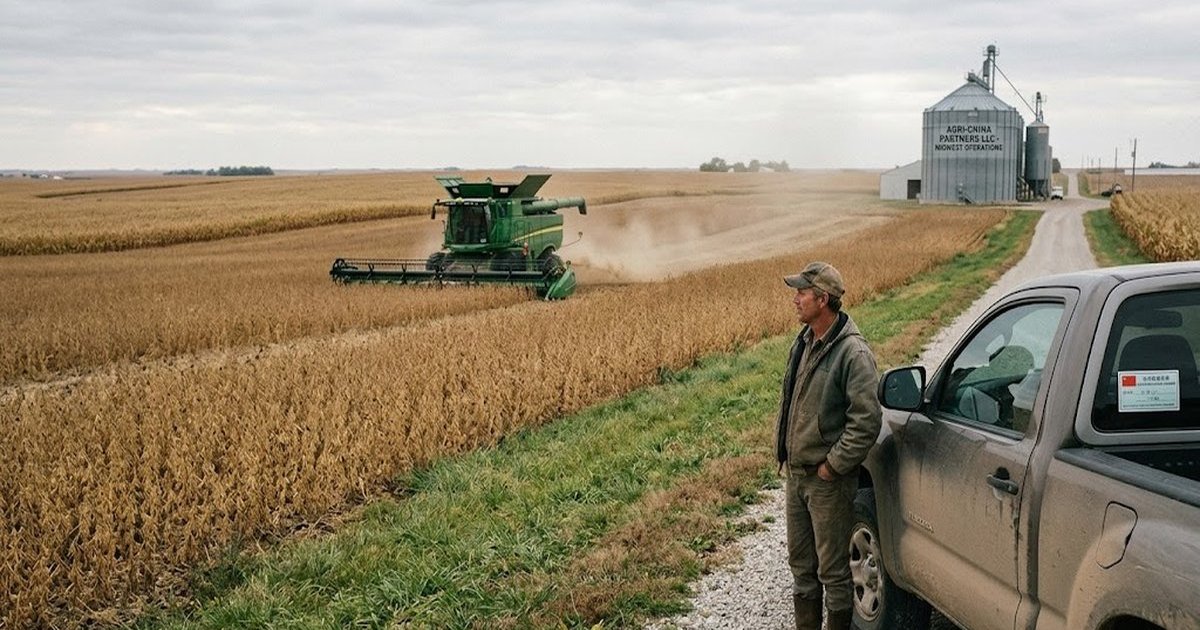
At its core, the debate over foreign ownership of U.S. farmland is about much more than just geopolitics and military bases; it is about the economic survival of the American family farm. Today, the men and women who wake up before dawn to grow our food are facing unprecedented economic headwinds. Biden-era inflation has driven up the cost of equipment, fertilizer, and seed, while profit margins continue to shrink under the weight of federal overregulation.
When foreign entities—especially those backed by the deep pockets of hostile foreign governments—enter the American real estate market, they artificially inflate rural land prices. A young, hardworking American family looking to expand their cattle operation or plant their first crop simply cannot compete with a multi-billion-dollar Chinese state-owned enterprise willing to pay well over market value for a plot of land. This dynamic fundamentally distorts the free market and threatens to price the next generation of American farmers out of their own heritage.
Furthermore, we must universally recognize that food security is, without question, national security. A nation that cannot feed itself is a nation that is beholden to the world. If we allow adversarial nations to incrementally buy up our fertile soil, our agricultural technology, and our food processing infrastructure, we are voluntarily handing them immense leverage over our domestic food supply.
The United States Constitution was designed to protect the rights, liberties, and property of American citizens, not to offer a clearance sale of our most vital resources to foreign adversaries. The ongoing efforts by state governors, local city councils, and conservative lawmakers in Washington show that Americans are finally waking up to the quiet takeover. By demanding strict government accountability, enforcing rigorous reporting standards, and prioritizing American buyers, we can ensure that the land of the free remains firmly in the hands of the brave.
Frequently Asked Questions
How much U.S. farmland does China actually own?
According to the USDA’s latest AFIDA reports, Chinese entities are linked to roughly 277,000 acres of American agricultural land. While this represents a fraction of a percent of total U.S. land, national security experts are primarily concerned with the strategic location of these purchases near critical military bases.
Can the federal government block foreign purchases of farmland?
Yes, through the Committee on Foreign Investment in the United States (CFIUS), the federal government can review and block transactions that pose a national security threat. However, CFIUS has historically faced jurisdictional limits regarding undeveloped greenfield land, prompting Congress to push for stricter oversight laws.
What are individual states doing to stop foreign land grabs?
Over 24 states have enacted laws restricting foreign ownership of agricultural land to protect their borders. For example, Arkansas recently utilized a state law to force a Chinese state-owned seed company to divest 160 acres of land and pay a $280,000 fine for failing to report its ownership.
This article was produced with AI assistance and reviewed by a human editor for accuracy and clarity. For more about our editorial standards, visit our About page.