

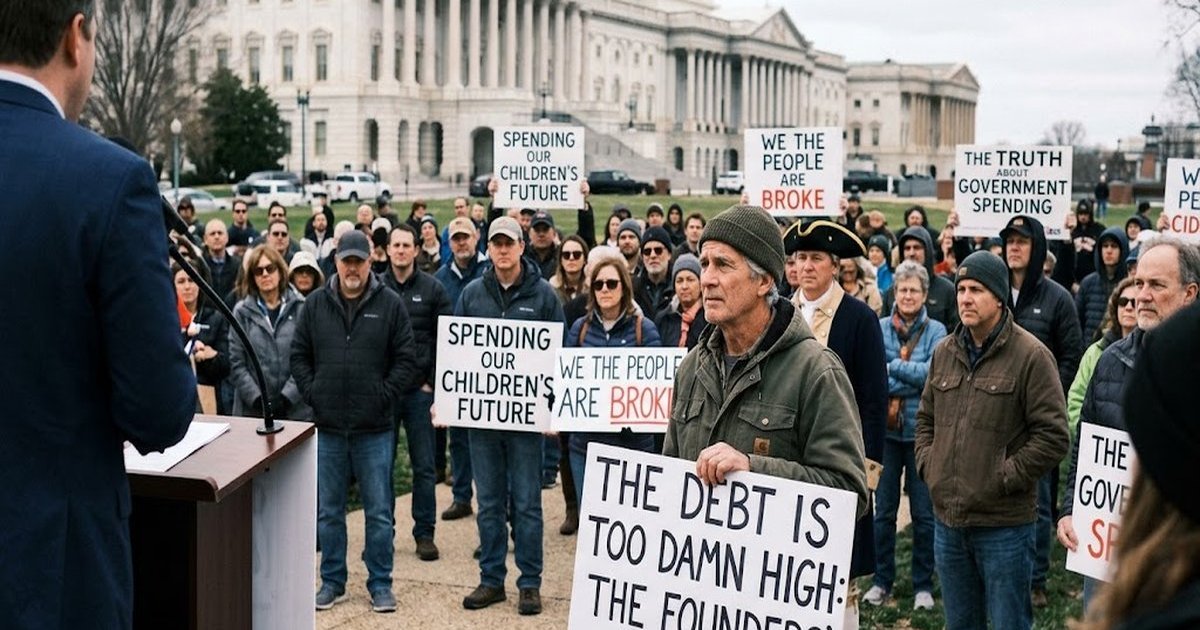
If you have sat at your kitchen table recently, staring at a stack of bills and a grocery receipt that seems impossibly high, you are not alone. Across the country, hardworking American families are feeling the squeeze of inflation. The Bureau of Labor Statistics continues to report the rising costs of everyday essentials—from the price of eggs and milk to the cost of keeping the lights on. But while everyday Americans are clipping coupons, driving less, and making tough financial sacrifices, the federal government seems to be operating by an entirely different set of rules.
According to the United States Treasury Department, our national debt surpassed a staggering $34 trillion in early 2024. To put that into perspective, the Congressional Budget Office (CBO) projects that the federal government will spend over $870 billion just on the interest payments for that debt this year. That means we are now spending more on debt interest than we are on our national defense. For conservative women, mothers, and grandmothers who manage household budgets with care and precision, this level of unchecked spending is not just irresponsible; it feels like a betrayal of our children’s future.
When we look at the chaos in Washington, it is natural to ask: Is this what the Founding Fathers intended? Did the men who drafted the blueprint for the greatest republic in human history foresee a government that spends trillions of dollars it does not have? The answer, found squarely in their own letters, speeches, and constitutional debates, is a resounding no. The Founders had very clear, strict views on government spending, debt, and the moral obligation we owe to future generations.
Thomas Jefferson and the Immorality of Generational Debt
If there was one Founding Father who understood the crushing weight of debt, it was Thomas Jefferson. While Jefferson struggled with personal debt throughout his life, his political philosophy regarding the nation’s finances was incredibly strict. He did not view the national debt merely as an economic issue; he viewed it as a profound moral failing. To Jefferson, borrowing money that future generations would be forced to pay back was a form of tyranny.
In a famous letter written to John Taylor in 1816, Jefferson stated plainly: “I sincerely believe, with you, that banking establishments are more dangerous than standing armies; and that the principle of spending money to be paid by posterity, under the name of funding, is but swindling futurity on a large scale.”
Jefferson believed in the fundamental family value of paying your own way. In an 1820 letter to the French philosopher Antoine Destutt de Tracy, he argued that “it is incumbent on every generation to pay its own debts as it goes.” He reasoned that no generation has the right to bind the next one to financial ruin. Think about how we raise our children today. We teach them to save their allowance, to avoid maxing out credit cards, and to live within their means. We would never dream of taking out massive loans in our children’s names, fully expecting them to foot the bill when we are gone. Yet, this is exactly what the federal government does every time it passes a massive, deficit-busting spending package.
Jefferson’s warning about “swindling futurity” is unfolding right before our eyes. The CBO estimates that the national debt will rise to 116 percent of the total U.S. gross domestic product (GDP) by 2034. Our children and grandchildren will inherit a nation where a massive portion of their hard-earned tax dollars will go strictly toward servicing the debt created by politicians long before they were even old enough to vote.
George Washington and the Danger to National Security
George Washington, the father of our country, approached the issue of government spending with his characteristic pragmatism and focus on national security. Washington led the Continental Army through a brutal war for independence, and he knew firsthand the difficulties of fighting a war without a properly funded treasury. He understood that some debt was necessary in times of extreme national emergency or existential war. However, he firmly believed that any debt accumulated during wartime must be aggressively paid off during times of peace.
In his iconic Farewell Address in 1796, Washington laid out his final warnings and advice to the American people. Among his most pressing concerns was the preservation of the nation’s financial integrity. He urged Americans to “cherish public credit,” explaining that the best way to do this was to use it as sparingly as possible. He warned against “the accumulation of debt, not only by shunning occasions of expense, but by vigorous exertions in time of peace to discharge the debts which unavoidable wars may have occasioned.”
Washington’s message was clear: do not throw the burden of your generation’s problems onto the backs of the next. He viewed fiscal responsibility as a matter of national defense. A nation drowning in debt is a weak nation, beholden to its creditors and vulnerable to foreign influence. Today, foreign investors and governments—including adversaries like China—hold trillions of dollars of U.S. debt. Washington would likely view our current financial dependency on foreign nations as a direct threat to the very independence he fought to secure.
James Madison and the Constitutional Limits of Spending
When politicians in Washington want to pass massive spending bills for pet projects, corporate bailouts, or sweeping new federal agencies, they almost always point to the “General Welfare” clause of the Constitution. They argue that because the Constitution allows the government to provide for the “general welfare of the United States,” they are authorized to spend money on practically anything they deem beneficial.
James Madison, widely recognized as the Father of the Constitution, would vehemently disagree. Madison was terrified of a centralized government with an open checkbook. He argued tirelessly that the powers of the federal government were meant to be “few and defined.” In Federalist No. 45, Madison reassured the American people that the new Constitution would not lead to an overbearing, heavily taxing central authority.
Madison believed that the “General Welfare” clause was not a blank check, but a general introduction to the specific, limited powers granted to Congress in Article I, Section 8. He proved his dedication to this principle during his presidency. In 1817, Congress passed the Bonus Bill, which would have used federal funds to build roads and canals across the country. Madison actually liked the idea of improving the nation’s infrastructure. However, he vetoed the bill. Why? Because he could not find a single clause in the Constitution that gave the federal government the authority to spend money on local infrastructure projects.
Madison understood a fundamental truth: if the government’s power to spend is virtually unlimited, then the government itself is virtually unlimited. Every dollar the federal government spends must first be extracted from the American taxpayer. By strictly limiting what the government could spend money on, Madison was actively protecting the property rights and the wealth of everyday American families.
The True Cost to Everyday Americans
So, why does this history matter to us today? It matters because the Founders’ warnings were not abstract philosophical debates; they were practical guidelines for maintaining a free and prosperous society. When we ignore these principles, everyday Americans pay the price.
Unchecked government spending directly impacts our daily lives in several specific ways:
- The Hidden Tax of Inflation: When the government spends trillions more than it takes in, it often relies on the Federal Reserve to print more money. This dilutes the value of the dollars in your wallet and your retirement accounts, driving up the cost of everything from groceries to gasoline.
- Higher Interest Rates: To finance massive deficits, the government must issue more Treasury bonds. This increased demand for borrowing pushes up interest rates across the board, making it more expensive for American families to secure a mortgage, buy a reliable car, or take out a small business loan.
- Threatened Safety Nets: As the interest on our national debt continues to consume a larger percentage of the federal budget, crucial programs that older Americans have paid into their entire lives, such as Medicare and Social Security, face increasingly precarious financial futures.
The Pew Research Center consistently finds that a majority of Americans view reducing the federal budget deficit as a top priority. Yet, Washington continues its spending spree, ignoring the mandate of the voters and the wisdom of the Founders.
Reclaiming the Constitutional Standard
As conservative women, we are the guardians of our family’s values and our nation’s heritage. We teach our children the importance of personal responsibility, hard work, and financial prudence. It is time we demand those exact same values from the men and women we send to Washington, D.C.
The Founding Fathers provided us with a magnificent framework for a free society, but it requires active maintenance. They understood that human nature is flawed and that politicians will naturally gravitate toward spending other people’s money to secure their own power. That is why they established a Constitution of limited, enumerated powers.
Getting our country back on track doesn’t require reinventing the wheel. It requires a return to the basics. It requires reading the Constitution not as a living document that changes with the political winds, but as a binding contract that limits federal overreach. By understanding what George Washington, Thomas Jefferson, and James Madison actually said about government spending, we arm ourselves with the historical truth. We must use that truth to hold our elected officials accountable, to vote for representatives who respect our tax dollars, and to ensure that we leave our children a nation defined by freedom and prosperity, rather than a legacy of insurmountable debt.
Frequently Asked Questions
Did the Founding Fathers ever carry a national debt?
Yes, after the Revolutionary War, the United States held significant debt from funding the military effort. However, leaders like Alexander Hamilton and George Washington believed in managing and paying it down responsibly to establish national credit, not accumulating it endlessly during peacetime.
What did the Founders mean by the “General Welfare” clause?
James Madison, the Father of the Constitution, argued that “General Welfare” was not a blank check for unlimited spending. Instead, it meant the federal government could only spend tax dollars on the specific, limited powers enumerated in Article I, Section 8 of the Constitution.
How does the national debt actually affect my family’s monthly budget?
High government spending often requires printing more money, which leads to inflation, making everyday goods like groceries and gas much more expensive. Additionally, massive government borrowing drives up interest rates, making it costlier for your family to get a mortgage, car loan, or carry credit card debt.
This article was produced with AI assistance and reviewed by a human editor for accuracy and clarity. For more about our editorial standards, visit our About page.