

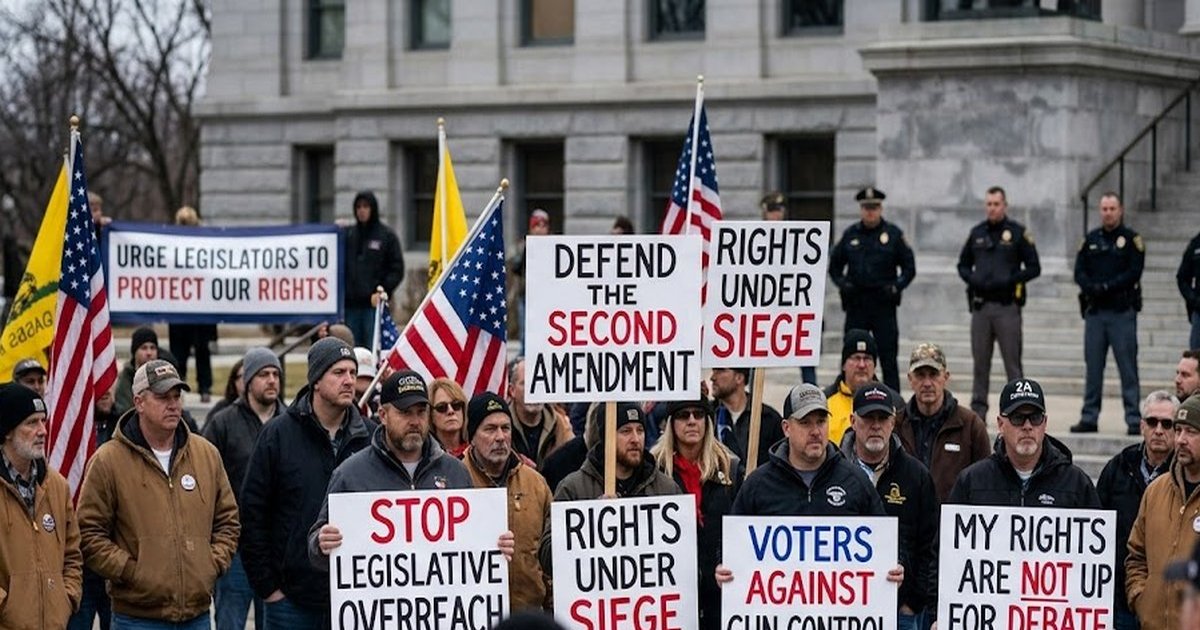
The Constitutional Stakes for American Families
As American citizens, our rights are not granted by the government; they are inherent, and the Constitution exists to protect them from government overreach. For generations, the Second Amendment has stood as a load-bearing pillar of American freedom. It ensures that everyday citizens have the means to defend themselves, their families, and their communities. But today, that fundamental right is facing a coordinated, multi-front legislative assault in Washington, D.C.
For many Americans, and particularly for women, a firearm is the ultimate equalizer. According to a 2023 Pew Research Center report, the number of women owning firearms has grown significantly over the last decade, with an overwhelming 71% of female gun owners citing personal protection as their primary reason for being armed. As mothers, grandmothers, and independent women, the safety of our homes is paramount. When crime rises and police response times lag—sometimes taking hours depending on where you live—you are your family’s first line of defense.
Yet, lawmakers who enjoy armed security details are actively pushing legislation that would strip everyday Americans of their ability to protect their loved ones. They use focus-group-tested buzzwords like “commonsense gun safety,” but the actual text of these bills tells a very different story. If you care about your family’s safety, government accountability, and your constitutional liberties, you cannot afford to look away. Here is a factual, detailed look at five specific bills currently winding their way through Congress that every freedom-loving American needs to watch closely.
Direct Bans: Stripping Away Your Right to Common Firearms
The most visible threats to the Second Amendment are direct bans on specific types of firearms. Politicians often point to tragic events to justify sweeping confiscations, ignoring the fact that criminals, by definition, do not follow laws. The primary targets of these bans are law-abiding citizens.
First on the radar is the Assault Weapons Ban of 2023 (S. 25 / H.R. 698). Championed originally by the late Senator Dianne Feinstein and continually reintroduced by congressional Democrats, this bill seeks to outlaw millions of commonly owned semi-automatic firearms. It is critical to understand that “assault weapon” is a made-up political term, not a technical one. This legislation bans firearms based primarily on cosmetic, ergonomic features—like pistol grips, adjustable stocks, and barrel shrouds. These features do not make a firearm fire faster; they make it safer and easier for people of different sizes (such as women) to handle properly.
To understand the disconnect between this legislation and reality, we only need to look at the government’s own data. According to the FBI’s 2024 Uniform Crime Reporting data, rifles of all types—not just the AR-15s targeted by this bill—were involved in roughly 2.5% of firearm homicides. You are statistically more likely to be murdered by someone using a knife, a blunt object, or even bare hands than by a rifle. Furthermore, the Congressional Budget Office (CBO) noted in its analysis of similar past bans that such legislation imposes massive unfunded mandates, costing the private sector millions of dollars in forgone revenue.
While S. 25 targets cosmetic features, the GOSAFE Act (S. 3369 / H.R. 8600), introduced by Senator Martin Heinrich, represents a stealthier, more dangerous approach. The Gas-Operated Semi-Automatic Firearms Exclusion Act abandons the focus on how a gun looks and instead targets how it functions. It seeks to ban firearms based on their internal gas-operated systems—the very mechanism that powers almost all modern semi-automatic rifles and shotguns used for hunting, sport, and home defense. Additionally, it limits magazines to 10 rounds. For context, a standard Glock 19, one of the most popular self-defense handguns for women, holds 15 rounds. The GOSAFE Act would severely limit the tools available for you to defend your home against multiple intruders.
Privacy and Due Process: The Push for Control Over Citizens
Beyond banning the hardware, federal lawmakers are also attempting to construct massive bureaucratic hurdles around the purchasing process, severely threatening citizen privacy and constitutional due process.
The Bipartisan Background Checks Act of 2023 (H.R. 715 / S. 494) is marketed to the public as a simple loophole closure. The truth is much more invasive. Currently, all commercial firearm sales through a Federal Firearms Licensee (FFL) require a background check through the FBI’s National Instant Criminal Background Check System (NICS). H.R. 715 aims to criminalize private, lawful transfers between everyday citizens. Under this bill, if a woman wants to buy a shotgun from her lifelong neighbor after a string of local break-ins, she cannot simply complete the transaction. Both parties would be forced to travel to a federally licensed dealer, pay processing fees, and enter their information into federal registries. This bill effectively turns a constitutional right into a heavily taxed, government-permission-slip privilege.
Perhaps even more alarming from a constitutional standpoint is the Federal Extreme Risk Protection Order Act of 2023 (H.R. 3018). This bill attempts to nationalize “Red Flag” laws. Under this legislation, federal courts would be authorized to issue orders allowing law enforcement to temporarily confiscate an individual’s firearms based on allegations that they pose a danger to themselves or others.
While keeping firearms out of the hands of genuinely dangerous individuals is a goal everyone shares, the mechanism of this bill should deeply trouble any constitutional conservative. These orders are often issued ex parte, meaning the accused is not present in court to defend themselves. Your property can be seized, and your Second Amendment rights suspended, before you have ever stood before a judge, seen the evidence against you, or been convicted of a crime. A disgruntled ex-spouse or a vindictive neighbor could make an accusation, and armed federal agents could show up at your door. This flips the American judicial standard of “innocent until proven guilty” entirely on its head, violating the core due process protections guaranteed by the Fifth and Sixth Amendments.
The Backdoor Approach: Bankrupting the Firearm Industry
When anti-gun politicians fail to ban firearms outright or register all gun owners, they turn to a third tactic: suing the firearm industry out of existence. This is the goal of the Equal Access to Justice for Victims of Gun Violence Act (H.R. 4184 / S. 2048).
To understand this threat, we must look back to 2005, when Congress passed the Protection of Lawful Commerce in Arms Act (PLCAA) with broad, bipartisan support. PLCAA was enacted to stop activist trial lawyers from bankrupting gun manufacturers through frivolous lawsuits. The concept is simple American common sense: You do not sue Ford or Chevrolet when a drunk driver causes a fatal accident. You do not sue Stanley if a criminal uses their hammer in a burglary. The individual who commits the crime is responsible.
H.R. 4184 would repeal the PLCAA, deliberately opening the floodgates for activists to sue firearm manufacturers—like Smith & Wesson, Ruger, and Glock—every time a criminal misuses one of their products. A 2024 report from the Bureau of Alcohol, Tobacco, Firearms and Explosives (ATF) noted that only about 11% of recovered crime guns were rifles of any kind; the vast majority are illegally obtained handguns circling the black market. Yet, this bill would hold the lawful manufacturers financially responsible for the actions of black-market criminals. The sheer cost of endless litigation would bankrupt these historic American companies. If civilian firearm manufacturers are driven out of business by trial lawyers, the Second Amendment becomes effectively void. You cannot exercise your right to bear arms if there is no one left to legally sell them to you.
What This Means for Everyday American Families
The Second Amendment is not about hunting, and it is not about target practice. It is the ultimate safeguard for the American family and a bulwark against tyranny. The five bills detailed above represent a coordinated, multi-pronged strategy to erode this right. They aim to ban the most effective self-defense tools (S. 25 and S. 3369), track and tax lawful transfers between citizens (H.R. 715), strip away due process (H.R. 3018), and bankrupt the companies that supply the civilian market (H.R. 4184).
Bureaucrats in Washington, D.C., do not know what it takes to keep your specific neighborhood safe. They do not know the layout of your home, and they will not be there to protect you in the middle of the night. True government accountability requires an educated and active electorate.
As conservative women, mothers, and patriots, it is our duty to stand firm. Read the bills. Track their progress. Call your representatives and demand they honor the oaths they took to uphold the Constitution. The defense of our liberties requires eternal vigilance, and the time to speak up for the Second Amendment is right now.
Frequently Asked Questions
What exactly is a “Red Flag” law?
A Red Flag law allows law enforcement to confiscate an individual’s firearms based on allegations that they are a danger to themselves or others. Often, these orders are granted before the accused has a chance to defend themselves in court, raising serious constitutional concerns about the denial of due process.
Doesn’t the federal government already require background checks to buy a gun?
Yes. Currently, every commercial firearm purchase made through a federally licensed dealer requires a background check through the FBI’s NICS system. Proposed “universal” background check bills actually target private transfers, making it a federal crime to sell or pass down a firearm to a neighbor or friend without going through a licensed dealer and paying fees.
Are semi-automatic rifles the same as military machine guns?
No. A machine gun fires continuously as long as the trigger is held down, and these have been heavily regulated by the federal government since 1934. A semi-automatic rifle, which is the most common type of firearm owned in America today, only fires one single bullet each time the trigger is pulled.
This article was produced with AI assistance and reviewed by a human editor for accuracy and clarity. For more about our editorial standards, visit our About page.