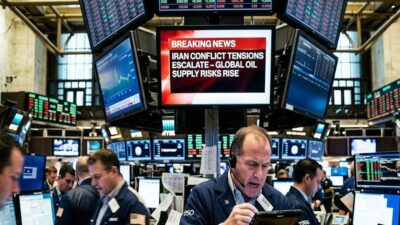

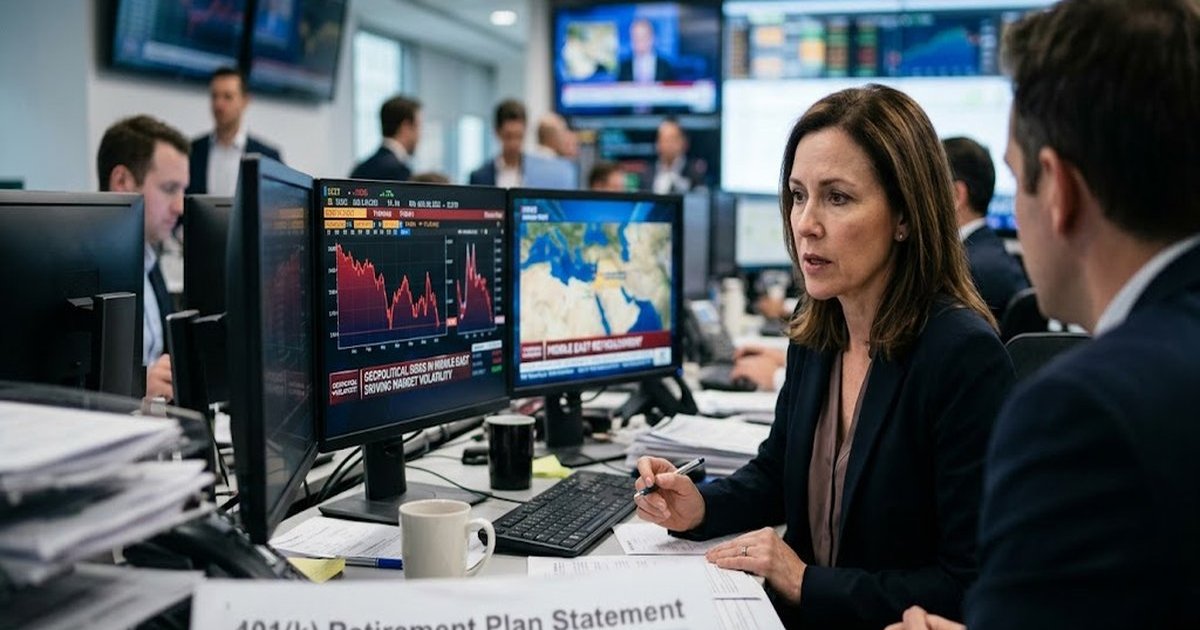
When breaking news notifications flash across your screen detailing fresh conflicts, escalating tensions, or diplomatic breakdowns in the Middle East, it is entirely natural to feel a knot in your stomach. Beyond the immediate humanitarian concerns, these geopolitical shocks often trigger a secondary anxiety for millions of Americans: What is going to happen to my life savings?
According to the Investment Company Institute (ICI), Americans hold more than $7 trillion in 401(k) retirement plans. These accounts represent decades of hard work, disciplined saving, and delayed gratification. Watching those balances fluctuate wildly in response to drone strikes or naval standoffs thousands of miles away can tempt even the most seasoned investor to hit the panic button. But before you log into your brokerage account to move everything to cash, it is critical to understand exactly how—and why—Middle Eastern crises affect the U.S. economy, and how you can shield your portfolio from the fallout.
Geopolitical crises are unpredictable, but the economic mechanisms they trigger are highly established. By stepping back from the chaotic headlines and examining the data, we can connect these global macro trends directly to your wallet. Here is a plain-English, data-driven look at how Middle East volatility impacts your 401(k) and the strategies historically proven to protect it.
The Global Energy Artery: Why the Middle East Moves Markets
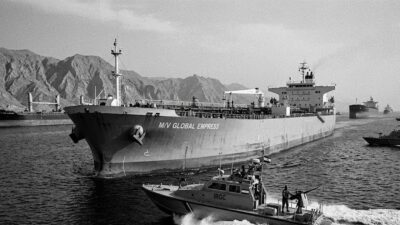
To understand why Wall Street cares so deeply about the Middle East, you only need to look at one commodity: crude oil. The Middle East is the beating heart of global energy production. Specifically, the region is home to the Strait of Hormuz, a narrow waterway between the Persian Gulf and the Gulf of Oman. According to the U.S. Energy Information Administration (EIA), roughly 21 million barrels of oil pass through this chokepoint every single day. That equates to roughly 20% of global petroleum liquids consumption.
When conflicts erupt in the region, commodity traders immediately price in what is known as a “geopolitical risk premium.” This is essentially an insurance policy built into the price of oil. Traders fear that a regional war could disrupt pipelines, damage refineries, or lead to blockades in the Strait of Hormuz. Because global oil supply chains run on tight margins, the mere threat of a disruption can send the price of a barrel of crude skyrocketing.
But how does the price of oil directly impact your retirement account? If you look under the hood of your 401(k), you likely own mutual funds or exchange-traded funds (ETFs) that track the S&P 500 or the total U.S. stock market. When oil prices surge, the cost of doing business increases for nearly every company in those funds. Airlines pay more for jet fuel; retailers pay more to ship consumer goods across the Pacific; and manufacturers pay more for the petroleum-based plastics required to build their products.
While energy sector stocks might enjoy a temporary boost, the broader stock market generally suffers when oil spikes. Profit margins shrink, corporate earnings guidance is revised downward, and stock prices fall as a result. This is the first and most immediate way a Middle East crisis shaves value off your 401(k) balance.
The Inflationary Domino Effect and the Federal Reserve
The damage caused by an oil shock rarely stops at corporate profit margins. It rapidly bleeds into the broader economy in the form of inflation. The Bureau of Labor Statistics (BLS), which calculates the Consumer Price Index (CPI), heavily weighs energy costs in its inflation metrics. When the cost to fuel a shipping truck goes up, the cost of the groceries inside that truck goes up, too. This phenomenon is known as “cost-push inflation.”
If a Middle East conflict is severe enough to cause sustained, elevated energy prices, inflation becomes a sticky problem for the U.S. economy. This is exactly what happened during the oil embargoes of the 1970s, which led to a decade of “stagflation”—high inflation coupled with stagnant economic growth.
When inflation rises, the Federal Reserve steps in. The Fed’s primary tool for fighting inflation is its benchmark interest rate, the federal funds rate. To cool down an overheating, inflationary economy, the Fed raises interest rates to make borrowing more expensive. However, higher interest rates act like gravity on stock prices.
Most modern 401(k) plans are heavily weighted toward large-cap growth stocks, particularly technology companies like Apple, Microsoft, and Amazon. These growth stocks are highly sensitive to interest rates because their valuations are based on future cash flows. When interest rates rise, the present value of those future earnings drops, taking stock prices down with them. Therefore, a crisis in the Middle East does not just threaten your portfolio through oil prices; it threatens it by forcing the Federal Reserve to maintain tight monetary policy, which suffocates stock market rallies.
History Lessons: Panic is Your Portfolio’s Greatest Enemy
Understanding the connection between Middle East geopolitics, oil prices, and stock valuations is crucial for your financial literacy. However, the most vital lesson comes from historical market data. History unequivocally shows that panicking during a geopolitical crisis is one of the most destructive things you can do to your long-term wealth.
Consider the Iraqi invasion of Kuwait in August 1990, which sparked the Gulf War. The invasion caused oil prices to double in a matter of months. In response, the S&P 500 plummeted nearly 20% by October of that year. If you had logged into your 401(k) during that terrifying autumn and sold your stocks to move into cash, you would have locked in those deep losses.
But what happened next? As the initial shock wore off and the U.S. military intervened, the market realized the worst-case economic scenarios were not going to materialize. By February 1991, just six months after the invasion began, the S&P 500 had fully recovered its losses. It went on to post a gain of over 30% that year.
This pattern has repeated itself time and time again. Research from the CFA Institute analyzing decades of stock market history reveals that while geopolitical shocks cause sharp, frightening market drawdowns, these drops are typically short-lived. Markets generally price in the “worst-case scenario” immediately, and then slowly recover as the actual outcome proves less apocalyptic. Selling your investments during the initial panic virtually guarantees that you will miss the subsequent recovery.
Defensive Strategies: Stress-Testing Your Retirement Plan
The goal is not to ignore the headlines, but to build a portfolio that is resilient enough to withstand them without requiring you to constantly trade in and out of the market. While specific investment advice requires consultation with a fiduciary financial planner, the following foundational strategies are widely used by professionals to protect retirement assets during global turmoil.
- Embrace Diversification: The old adage about not putting all your eggs in one basket is your best defense against geopolitical risk. If your 401(k) is 100% invested in U.S. large-cap tech stocks, you are highly exposed to interest rate hikes. A well-constructed portfolio includes domestic stocks, international stocks, and a stabilizing allocation of bonds. U.S. Treasury bonds, backed by the full faith and credit of the government, often act as a safe haven; when investors flee the stock market in fear, they typically buy Treasuries, driving their prices up and offsetting some of your stock losses.
- Understand Your Target Date Fund: The majority of Americans today are enrolled in Target Date Funds (TDFs), which automatically adjust their risk profile as you get closer to retirement. For example, a “2050 Fund” will be heavily invested in stocks right now, meaning it will drop significantly during a Middle East crisis. A “2025 Fund” will be heavily invested in bonds and cash equivalents, buffering the shock. Knowing what you actually own prevents you from being surprised by your balance.
- Maintain Your Rebalancing Discipline: Over time, a bull market might cause your portfolio to drift. If your target is 70% stocks and 30% bonds, a long period of market growth might push you to 85% stocks, leaving you overly exposed when a crisis hits. Rebalancing—selling high-performing assets to buy underperforming ones—forces you to lock in gains and buy assets when they are cheap. Many 401(k) providers offer an “auto-rebalance” feature that does this for you once a year.
- Build an External Cash Buffer: The worst-case scenario during an economic shock is losing your job and being forced to withdraw money from your 401(k) while the market is down. Not only do you lock in investment losses, but the IRS imposes a 10% early withdrawal penalty on top of ordinary income taxes if you are under age 59½. Maintaining an emergency fund of three to six months’ worth of living expenses in a high-yield savings account ensures you never have to raid your retirement to survive a temporary crisis.
The Long View: Staying the Course Through Volatility
Perhaps the most powerful, yet counterintuitive, tool at your disposal during a geopolitical crisis is the sheer mechanics of your bi-weekly paycheck. Every time you get paid, a portion of your income goes straight into your 401(k). This happens whether the market is hitting all-time highs or suffering a double-digit correction.
This automated process is called Dollar Cost Averaging (DCA). When a conflict in the Middle East drives the stock market down, your regular payroll contribution is suddenly buying shares at a significant discount. You are accumulating more shares for the exact same amount of money. When the conflict eventually resolves and the market recovers—as it historically always has—those shares you bought during the crisis will be the engines of your portfolio’s future growth.
The global economy is a massive, highly adaptable machine. While the United States is deeply integrated into global supply chains, it is also highly resilient. In fact, the U.S. has significantly increased its domestic oil and gas production over the last decade, transitioning to a net exporter of petroleum. While global prices still dictate domestic costs, this energy independence provides a stronger buffer against Middle East shocks today than America enjoyed in the 1970s or 1990s.
Geopolitical crises will always generate frightening headlines and short-term market volatility. Your job as a long-term investor is not to predict when these conflicts will begin or end. Your job is to construct a diversified portfolio, automate your savings, and have the emotional discipline to let the global economy do what it has done for over a century: innovate, adapt, and grow over time. The next time the news alerts flash, take a deep breath, review your long-term strategy, and remember that patience has always been the most profitable asset class.
Frequently Asked Questions
Should I move my 401(k) out of stocks and into cash during a war?
Financial experts strongly advise against moving your investments to cash during a crisis. Market timing is notoriously difficult; while you might avoid some losses, you will likely miss the market’s sudden recovery, permanently damaging your long-term compound growth.
How does the price of oil directly lower the value of my mutual funds?
Surging oil prices increase transportation and manufacturing costs for nearly all businesses, which shrinks corporate profit margins. When companies are projected to make less money, their stock prices drop, which lowers the overall value of the mutual funds holding those stocks.
Are Target Date Funds safe from geopolitical shocks?
No investment is entirely immune to market volatility, but Target Date Funds are designed to manage risk appropriately based on your age. If you are decades away from retirement, the fund will hold mostly stocks and will drop during a crisis, but it has time to recover; if you are near retirement, it will hold more conservative bonds to protect your capital.
This article was produced with AI assistance and reviewed by a human editor for accuracy and clarity. For more about our editorial standards, visit our About page.