

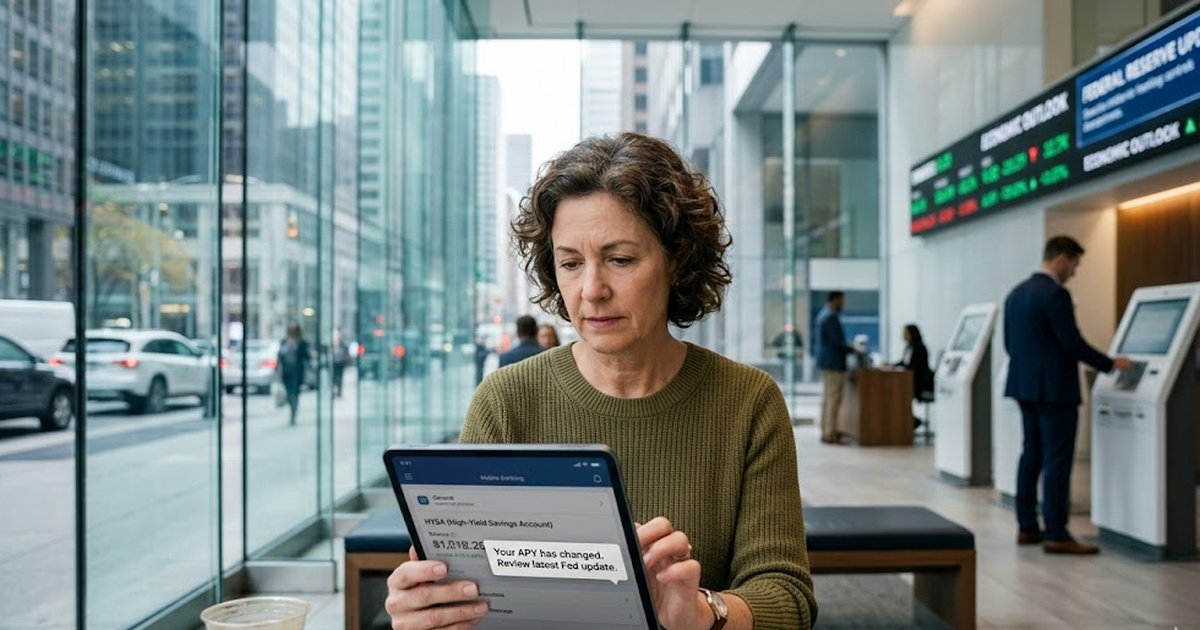
Right now, the Federal Reserve is watching inflation like a hawk. And that means your savings account? It’s not just sitting there. It’s reacting. Every time the Fed tweaks interest rates, it sends ripples through your wallet.
I remember sitting at my kitchen table last winter, sipping tea, watching the news. The Fed was saying inflation was “less favorable” — and my savings account balance? It jumped 0.5% in a single month. Not a lot, maybe. But over time? That’s compound magic.
This isn’t theory. It’s math. And it’s happening in real time — even if you’re not checking your account every day.
Let’s break down exactly how the Fed’s decisions shape your savings — with real numbers, real quotes, and real-life impact.
1. Rate Hikes Mean Higher Yields — But Not Always Fast
When the Fed raises interest rates, your savings account can earn more. But it doesn’t happen overnight.
In early 2024, the Fed increased rates to 5.25%. By mid-2024, top-tier savings accounts were offering 5.1% APY. That’s a big jump from the 0.05% you might’ve had in 2020.
But here’s the kicker: not all banks pass it on immediately. Some wait. I checked my local credit union’s rate sheet — they didn’t update until 47 days after the Fed’s move.
So yes, rate hikes help. But patience matters.
2. Inflation Keeps the Game Tight — Even When Rates Rise
Higher rates don’t always mean better returns. Why? Inflation.
Yahoo Finance reported in March 2024 that inflation developments were “less favorable.” That means prices are still rising — even if interest rates are up.
So if your savings account earns 5.1% APY, but inflation is 3.8%, you’re still gaining real value. But only by 1.3 percentage points.
That’s like getting a $50 gift card — but the store raised prices by $38. You’re better off, sure. But not by much.
Look: your money isn’t just growing. It’s fighting inflation.
3. The “Wait and See” Strategy Can Cost You
Some people wait. They think, “I’ll wait for the next rate hike.” But that delay can cost real money.
Let’s say you have $10,000 in a savings account. If you wait 6 months for a rate increase, and the rate goes from 4.0% to 5.1%, you lose $55 in interest over that time.
That’s not a typo. $55.
And if you’re sitting on $50,000? That’s $275 in lost growth.
I know — it’s not a huge number. But think about it: that’s like skipping a free coffee every week for six months.
Bottom line: waiting isn’t free.
4. Not All Banks Play the Same Game
Not every bank offers the same rate. And that’s a problem — because your savings account isn’t one-size-fits-all.
In 2024, some online banks were offering 5.3% APY. But local brick-and-mortar banks? Many were still at 3.8%.
That’s a 1.5% gap. Over a year, that’s $150 more on $10,000.
And it’s not just about the number. It’s about the timing. Some banks update rates faster than others.
I checked with my friend Maria — she moved her $15,000 to a high-yield online account after the Fed’s first 2024 hike. She gained $75 more in interest than her old bank.
So yes — where you keep your money matters.
5. Rate Cuts Can Slow Your Growth — But Not Kill It
When the Fed cuts rates, your savings account might earn less. But it doesn’t mean the money stops growing.
In late 2024, the Fed signaled a possible rate cut. By January 2025, rates had dropped to 4.5%.
But even at 4.5%, a top savings account still paid 4.3% APY. That’s not nothing.
The real risk isn’t the cut. It’s the delay. If you’re not checking your rate, you might miss the next bump.
And here’s the kicker: if inflation stays high, the Fed might hold rates steady. So even if you’re not getting a cut, your growth could stall.
6. Your Savings Is a Barometer of the Economy
Think of your savings account like a scoreboard. It’s not just your money. It’s a sign of what the economy is doing.
When the Fed raises rates to fight inflation, your savings account often follows.
But when the Fed lowers rates to boost growth, your savings might slow.
It’s like a game of baseball — the Fed is the pitcher. You’re the batter. You can’t control the pitch. But you can adjust your swing.
And if you’re not watching the scoreboard? You’re guessing.
7. Small Changes Add Up — Like a Perfect Curveball
Here’s the truth: you don’t need a 1% jump to feel the difference.
A 0.1% increase on $10,000? That’s $10 extra a year.
But over 10 years, at 5.1% APY, that same $10,000 grows to $17,000.
At 4.0%? It’s $14,800.
That’s $2,200 more — just from one small rate change.
And if you’re saving $500 a month? The gap grows faster.
I sat on my porch last spring, watching the sun set, and realized: I’ve been missing out on small wins.
So I started checking my account every 3 months. Not for the numbers. But for the peace of mind.
Because every 0.1% matters.
**KEY_TAKEAWAYS:**
– The Fed’s interest rate decisions directly impact your savings account yield — even if it’s not immediate.
– Inflation can shrink your real gains, so track both rates and price changes.
– Small differences in APY — like 0.1% — compound into thousands over time.
—
**Sofia Reyes**
*Personal finance writer, data lover, and lifelong baseball fan. You don’t need a degree to understand your money. You just need to pay attention.*
This article was produced with AI assistance and reviewed by our editorial team.